News

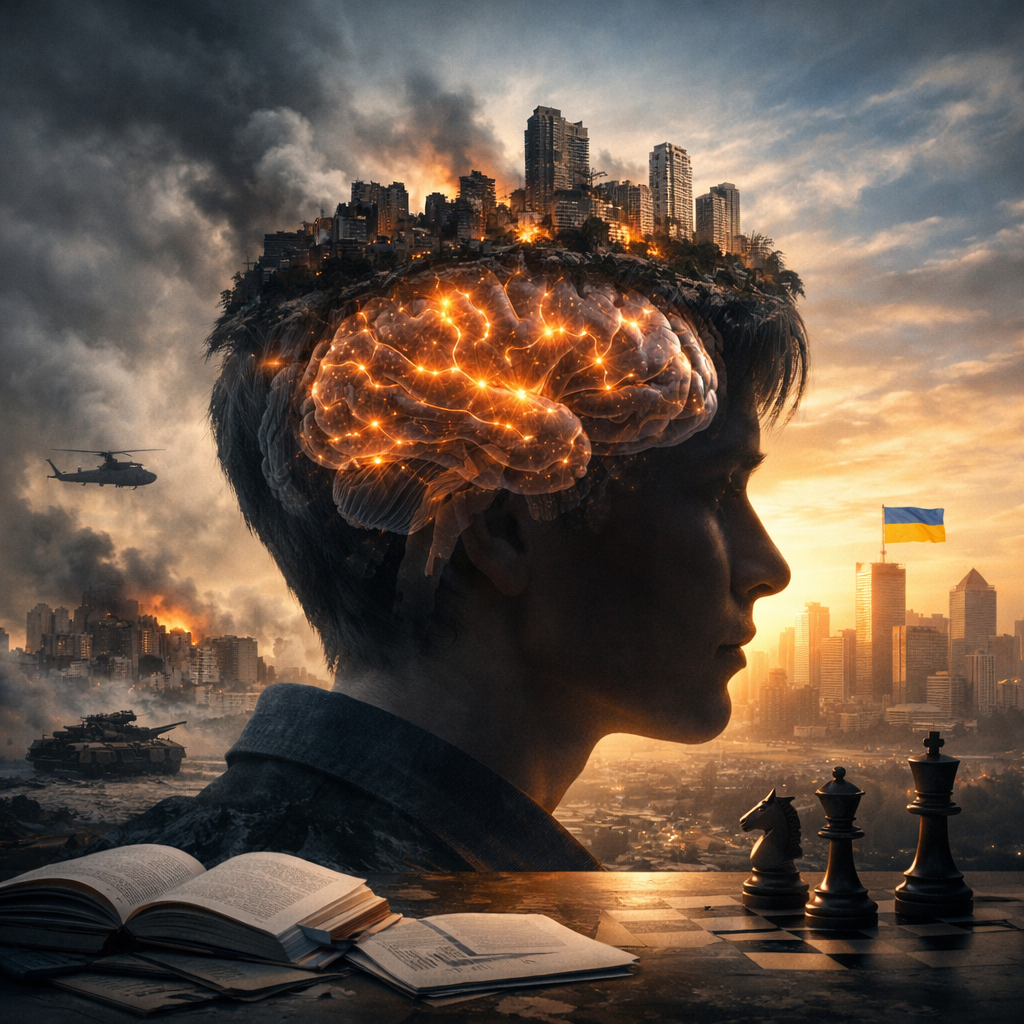
Ukraine, psychedelic medicine and the new architecture of mental health: what the debate in the European Parliament means for the future
11May

Ukraine, psychedelic medicine and the new architecture of mental health: what the debate…

The European Parliament held a discussion on the prospects of psychedelic-assisted therapy, a field that is increasingly being researched around the world as a potential tool for helping people with severe mental disorders resistant to standard treatment. Representatives of our institute also joined the international discussion, presenting the Ukrainian perspective on the development of innovative approaches in the field of mental health in wartime. For Ukraine, this topic has long ceased to be just a scientific discussion or a theoretical question of the future. A full-scale war has changed the very structure of the mental health of society. Daily losses,…


Burnout as a new epidemic: what has Europe already understood, but Ukraine is just getting started? A view through the prism of European integration
20Apr

Burnout as a new epidemic: what has Europe already understood, but Ukraine is…

Ukraine’s European integration is usually associated with reforms in the economy, law, security, or medicine. But there is one area that remains almost outside of public discussion, although it actually determines the effectiveness of all the others. This is mental health and, in particular, burnout. We are used to perceiving burnout as an individual problem. As a condition of a specific person who “couldn’t stand it”, “got too tired”, “couldn’t cope”. But modern European logic has long been different. Burnout is not a human weakness, it is symptom of the system. And if we look at Ukraine today honestly, we…

Why is the conflict between doctors and management destroying hospitals from within?
18Apr

Why is the conflict between doctors and management destroying hospitals from within?

There are things that are not visible in financial statements, but that determine the fate of an organization much more strongly than numbers. One such factor is the relationships between the people who make up the system. In the case we analyzed from the US, the financial crisis was only an external manifestation. Inside the hospital, something else was happening – a deep conflict between doctors and administration. This conflict did not arise suddenly. It was formed gradually, as is often the case in complex systems. Doctors felt that management did not understand their reality. That decisions were made without…

Why don’t cuts save hospitals and why is this logic dangerous for Ukraine?
18Apr

Why don’t cuts save hospitals and why is this logic dangerous for Ukraine?

When a hospital finds itself in financial crisis, the simplest and most intuitive response is to downsize. Cut costs, cut staff, limit activities, postpone development. This seems like a rational management decision, especially in a context of limited resources. But when we analyzed the transformation of a hospital in the United States, which was experiencing a deep financial downturn, something else struck me: cuts there were not the solution. They were a temptation that could ultimately destroy the system. By the time the new management came to the hospital, it had already accumulated significant losses and was under pressure –…

Why are medical errors a problem of the system, not of people?
18Apr

Why are medical errors a problem of the system, not of people?

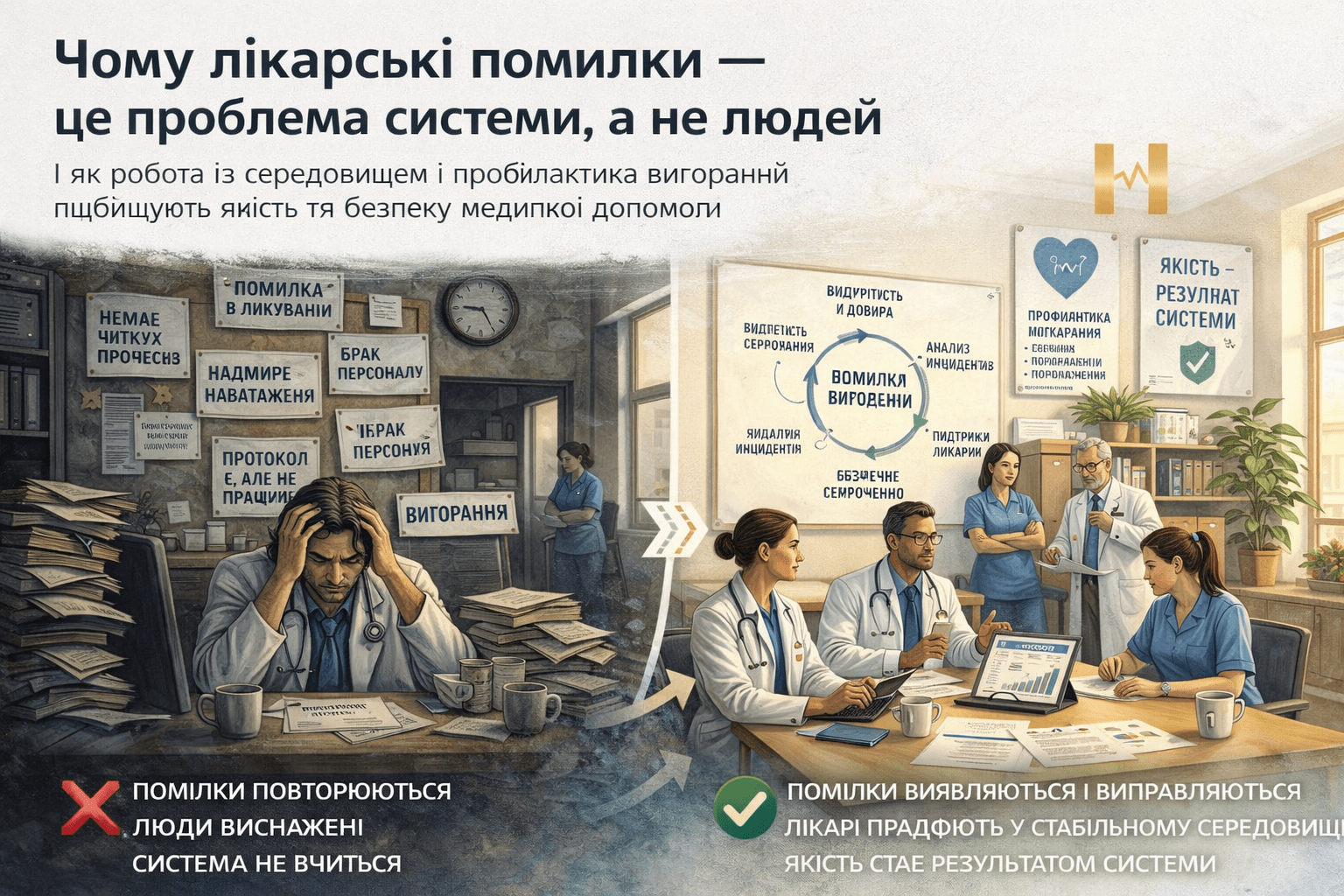
When we talk about medical errors, we almost always talk about people. It seems logical: the doctor makes the decision, so the responsibility is personal. But the deeper we delved into the transformation of one hospital in the United States that went through a crisis and managed to emerge from it, the more this logic began to seem simplistic. The errors there did not disappear after doctors were “reminded of the standards” or after stricter controls. They began to decrease when the system learned to see them. This is an unobvious moment, but it is the one that changes everything.…

When control becomes fear: how hospital raids can change not only the system, but also the very nature of medicine in Ukraine
18Apr

When control becomes fear: how hospital raids can change not only the system,…

Last week, the Ukrainian healthcare system witnessed an event that many perceived as another wave of corruption. Mass searches in hospitals across the country seem like a logical response by the state to abuse of budget funds. But if you look at it more broadly, this is not about individual criminal proceedings, it is about changing the rules of the game. Ukrainian medicine is entering a new phase – a phase where trust is no longer the basic principle of the system. It is being replaced by control. And it is this shift, not the searches themselves, that will determine…

The Ukrainian Formula for Resilience: How the Experience of War Can Change the World’s Mental Health Science.
18Apr

The Ukrainian Formula for Resilience: How the Experience of War Can Change the…

For decades, modern medicine and psychology have studied stress mostly in stable societies. Studies of depression, anxiety disorders, post-traumatic stress disorder, and burnout have been shaped primarily by examples of individual trauma or short-term crises—accidents, natural disasters, local military conflicts, or personal losses. This knowledge has become the foundation of modern psychiatry and psychosomatic medicine. However, the full-scale war in Ukraine has created a situation that has practically no analogues in modern science. It is not only about the scale of the trauma or the duration of the stress, it is about a phenomenon that is increasingly attracting the attention…

National Mental Resilience Index: a new macroeconomic indicator for Ukraine?!
18Apr

National Mental Resilience Index: a new macroeconomic indicator for Ukraine?!

Ukraine has learned to count losses, but we still don’t count resources. We measure GDP, inflation, budget deficit, the amount of international aid, but we don’t measure what directly affects all these indicators – the mental resilience of the nation. The world has long recognized that mental health is an economy. According to WHO estimates, depression and anxiety disorders cost the global economy more than $1 trillion each year in lost productivity. The OECD estimates that mental health problems can cost countries up to 4–5% of GDP. For Ukraine, which is living in a state of full-scale war, these risks…

A country that does not measure its resilience risks losing it!
18Apr

A country that does not measure its resilience risks losing it!

When the state does not measure the mental state of society, it acts blindly. Ukraine today is a country of extraordinary endurance. But endurance is not infinite. Four years of full-scale war have created a new reality: fatigue accumulates, trust fluctuates, the planning horizon is shortened, and conflict is increasing. And, at the same time, society continues to function. This is the paradox of Ukrainian resilience. But paradoxes cannot replace politics. Mental resilience is a political issue. If the government measures inflation every month, but does not measure the level of anxiety and burnout in professional groups, it ignores a…

Mental resilience as a factor of national security: what should the state start measuring today?
18Apr

Mental resilience as a factor of national security: what should the state start…

Ukraine is in a state of protracted war. We are talking about weapons, economy, mobilization, international support, but there is another resource without which none of these factors work – mental resilience. And if the state does not include it in the national security system, it leaves a critical risk out of control. This is not an emotional topic. This is a question of risk management. Chronic stress doesn’t look like a crisis. It looks like “wartime normality.” But at the economic level, it means reduced concentration, a shortened strategic planning horizon, an increase in errors, a decrease in creativity…

Professional burnout of doctors, military personnel, and managers: the hidden epidemic of war
18Apr

Professional burnout of doctors, military personnel, and managers: the hidden epidemic of war

Ukraine has learned to live in conditions of constant tension. But there is a factor that is not visible in the General Staff reports and is not reflected in macroeconomic reports. This is professional burnout. Wartime creates an unprecedented burden on those who keep the state running: doctors, military, administrators, critical infrastructure workers. Formally, the system works, but its internal resources are gradually depleted. Burnout becomes a hidden epidemic of war. Professional burnout is not just fatigue. It is a complex syndrome that includes emotional exhaustion, decreased efficiency, cynicism or detachment, and a loss of a sense of meaning in…

Mental health as an economic category: how much does burnout cost the country?
18Apr

Mental health as an economic category: how much does burnout cost the country?

Ukraine counts the budget to the hryvnia, but does not count fatigue. We analyze tax revenues, deficits, and international aid in detail. However, we hardly talk about the factor that directly affects all these indicators – the mental state of the working population. The world has long recognized that mental health is an economic category. Ukraine is just getting started. According to WHO estimates, depression and anxiety disorders cost the global economy more than $1 trillion each year in lost productivity. The OECD estimates that mental health problems cost the world economy 4–5% of GDP in developed countries. In the…

Cognitive longevity in wartime: can a nation maintain clarity of thought?
18Apr

Cognitive longevity in wartime: can a nation maintain clarity of thought?

War destroys cities, but it also changes the brain. Ukraine has been living in a chronic stress mode for four years. We talk about losses, about the economy, about security. Less often about how long-term stress affects the cognitive function of society. The question is broader: can a nation maintain clarity of thought under conditions of prolonged stress? This is not just a question of medicine, it is a question of the future competitiveness of the state. Stress is a natural reaction of the body. Short-term stress mobilizes. But chronic stress is exhausting. Prolonged increase in cortisol levels affects the…