
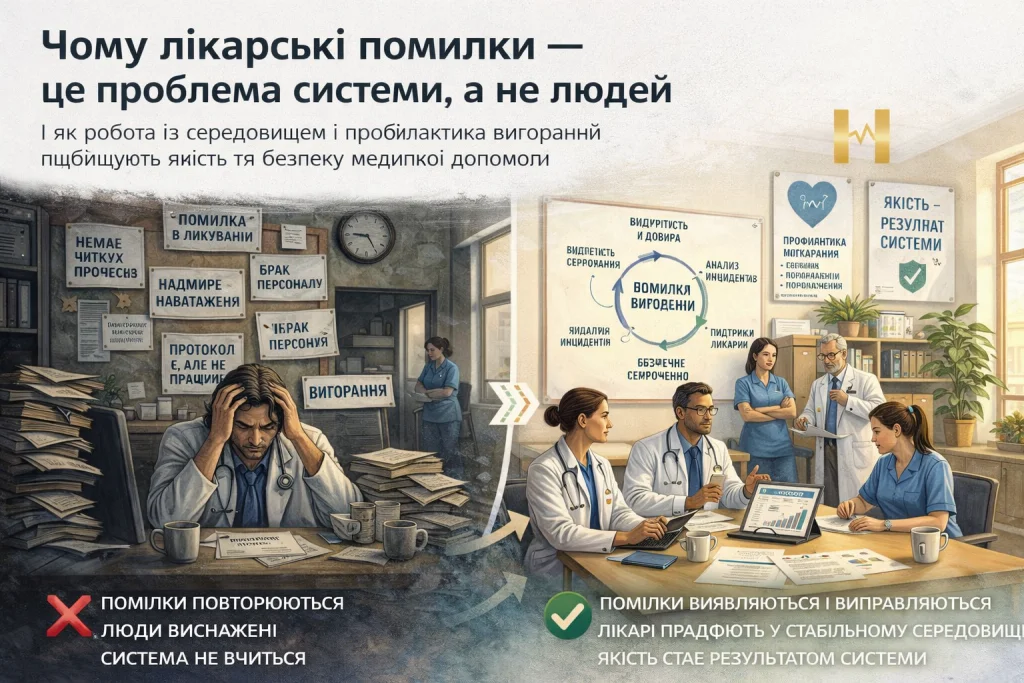
When we talk about medical errors, we almost always talk about people. It seems logical: the doctor makes the decision, so the responsibility is personal. But the deeper we delved into the transformation of one hospital in the United States that went through a crisis and managed to emerge from it, the more this logic began to seem simplistic.
The errors there did not disappear after doctors were “reminded of the standards” or after stricter controls. They began to decrease when the system learned to see them. This is an unobvious moment, but it is the one that changes everything.
Before the changes, the hospital functioned like most complex organizations: information about problems remained local, patient complaints were recorded but not subject to systematic analysis, and incidents did not rise to a level where processes could be changed. Formally, the system worked. But it lacked the ability to learn. And that is what is crucial.
When management changed its approach and began to treat each case not as a problem to be closed, but as a signal to be understood, the system began to change. Not because of new protocols, they existed before. But because of a different logic of interaction. People started to talk. Information stopped being blocked. Weaknesses became visible. And with it, quality began to change.
But there is another level to this story, which was felt very clearly in that case, although it was not formulated directly. And which is critical in the Ukrainian context.
This is the doctor’s status in the system.
We almost never connect medical errors with burnout. We talk about workload, staff shortages, difficult conditions, but we don’t bring it all into a single logic. And yet, this connection is one of the key ones. Because burnout is not about emotions. It’s about functioning.
A doctor who works in a state of chronic exhaustion works differently. He makes decisions more slowly. He has poorer attention span. He often acts automatically where concentration is required. This is not a question of professionalism – it is a question of resources. And if the system is built in such a way that this resource is constantly depleted, it itself creates conditions for errors.
In that hospital, it was palpable: tension, conflicts, constant pressure, lack of trust – all this created an environment in which even strong specialists worked on the edge. And it was changing this environment – through openness, through dialogue, through the involvement of management – that became part of the solution. Not a separate program. But a change in the very fabric of the system.
When we look at Ukraine today, we see that we are trying to solve the problem of quality in a different area. We are relying on regulation. On standards, protocols, inspections that are formed by the Ministry of Health. This is necessary. But this is not enough. Because quality does not arise where there are only rules. It arises where the system is able to: see itself, understand itself and not destroy those who work in it.
Today, a Ukrainian doctor works in conditions that objectively increase burnout. War, overload, staff shortages, financial instability at the institution level – this is not a background, it is a factor that affects the quality of the decision. And at the same time, this factor is practically absent in politics.
We don’t think of burnout as part of the healthcare system. We think of it as a personal problem. But if we accept a different logic, that the condition of a doctor is part of the quality system, the approach to decisions also changes. Then the prevention of burnout ceases to be an “additional option” or a social project. It becomes an element of security. And then the question sounds different: not “how to support a doctor”, but “how to create a system in which a doctor can work stably without losing quality”.
In that case, the answer was formed gradually. Through a change in management, through inclusion, through openness, through building an environment in which people stopped working on the verge of constant tension. And this gave a result no less important than financial stabilization.
If we transfer this logic to the Ukrainian context, it becomes clear that the next stage of reform cannot be limited to funding through the National Health Service or regulation through the Ministry of Health. It must include working with the system itself, as an environment. With how processes are organized. How the workload is distributed. How the doctor interacts with management. How the system reacts to errors and stress. Because in the end, the quality of medicine is determined not only by the doctor’s knowledge. It is determined by the state in which he applies this knowledge.
And therefore: a system that does not see its mistakes and does not support its doctors will inevitably reproduce these same mistakes again. And this is no longer a question of individual cases, it is a question of the design of the entire healthcare system.