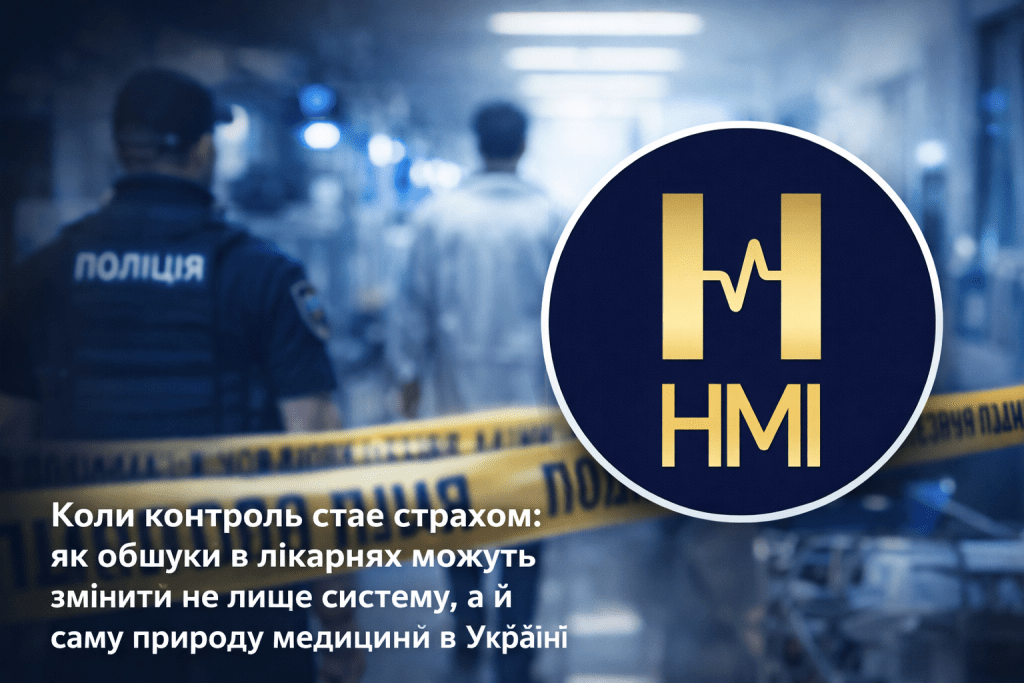
Last week, the Ukrainian healthcare system witnessed an event that many perceived as another wave of corruption. Mass searches in hospitals across the country seem like a logical response by the state to abuse of budget funds. But if you look at it more broadly, this is not about individual criminal proceedings, it is about changing the rules of the game.
Ukrainian medicine is entering a new phase – a phase where trust is no longer the basic principle of the system. It is being replaced by control. And it is this shift, not the searches themselves, that will determine how medicine will work in the coming years.
The model built through the National Health Service of Ukraine was revolutionary for Ukraine. It gave hospitals financial autonomy and created a new logic: the state pays for the service actually provided. This allowed the system to adapt quickly, launch competition, and give medical institutions the tools to develop. But at the same time, the model built an incentive that had long been overlooked: the more services declared, the more funding the institution received. This was not a mistake. This was the logic of the system. And it was this logic that shaped behavior.
Today, the state is effectively questioning not just individual hospital actions, but the very principle on which the interaction was built. And therein lies the main tension: a system that encouraged certain behavior is now beginning to criminalize it. But the biggest impact of these events will not be legal or even economic. It will be psychological!
Ukrainian doctors have been working in a state of chronic exhaustion for several years now. The war, the constant flow of patients, the shortage of personnel, the emotional strain – all this has created an unprecedented level of professional burnout. And it is at this moment that a new factor enters the system: personalized criminal risk.
The doctor starts thinking beyond the patient and the clinical decision. He starts thinking about the consequences. About how the recording will be interpreted. About whether his action will become part of a criminal case. It changes the very nature of medical practice.
In world medicine, there is a term for this – defensive medicine. Defensive medicine arises when a doctor works not to achieve the best result, but to minimize his own risks. In such a system, decisions become more cautious, sometimes excessively formal, and sometimes simply safe from a legal point of view, but not optimal for the patient.
This is especially dangerous for Ukraine, because the system is already operating at the limit of its resources.
Another dimension of this transformation is digital. Data in eHealth, which was created as a tool for transparency, is now becoming a tool for evidence. Each record is not just part of the medical history, it is a digital trace that can be used in the legal process. And this is shaping a new behavior: the doctor begins to fear not the error, but its fixation.
This is a subtle but critical change.
It leads to a loss of openness, self-censorship, and a decrease in the quality of communication within the system.
A separate level of pressure falls on the heads of medical institutions. In fact, a new legal reality is being formed in which the director is responsible for the entire system – regardless of whether he had the opportunity to control each individual process. This inevitably pushes managers towards tighter control, greater formalization and increased internal pressure on staff. But control has its price. When the system starts to work out of fear, it loses flexibility. It stops generating initiative. It starts to reproduce only safe scenarios. In the short term, this may look like “cleaning the system”. But in the long term, it risks its paralysis. Because medicine is always work with uncertainty. And if every decision can potentially be interpreted as a violation, the doctor stops making decisions as such.
This is where a new type of burnout arises, which is almost never discussed. This is not classic emotional exhaustion. This is institutional burnout – a state when a person loses trust in the system in which he works and ceases to feel the meaning of his role in it. This is the most dangerous form of crisis. Because it does not always manifest itself immediately. It accumulates. And then it turns into an outflow of personnel, formalization of work and a decrease in the quality of care.
In the coming years, we will most likely see a wave of criminal cases, some of which will be made public. Contract audits will be intensified, approaches to financing will change, and the control system will become stricter. But this is not the key question. The key question is whether the state will be able to find a balance?
Control is necessary in a system. But if it completely replaces trust, the system ceases to be viable.
Medicine cannot operate solely on the logic of verification and punishment. It needs space for clinical judgment, for professional responsibility, and for error that is not a crime.
Today’s searches are not about the past. They are about what Ukrainian medicine will be like tomorrow. And this choice is much more complicated than simply “tightening control.” It is a choice between a system that is afraid and a system that works. And the difference between them is not only efficiency. It is the lives of patients!